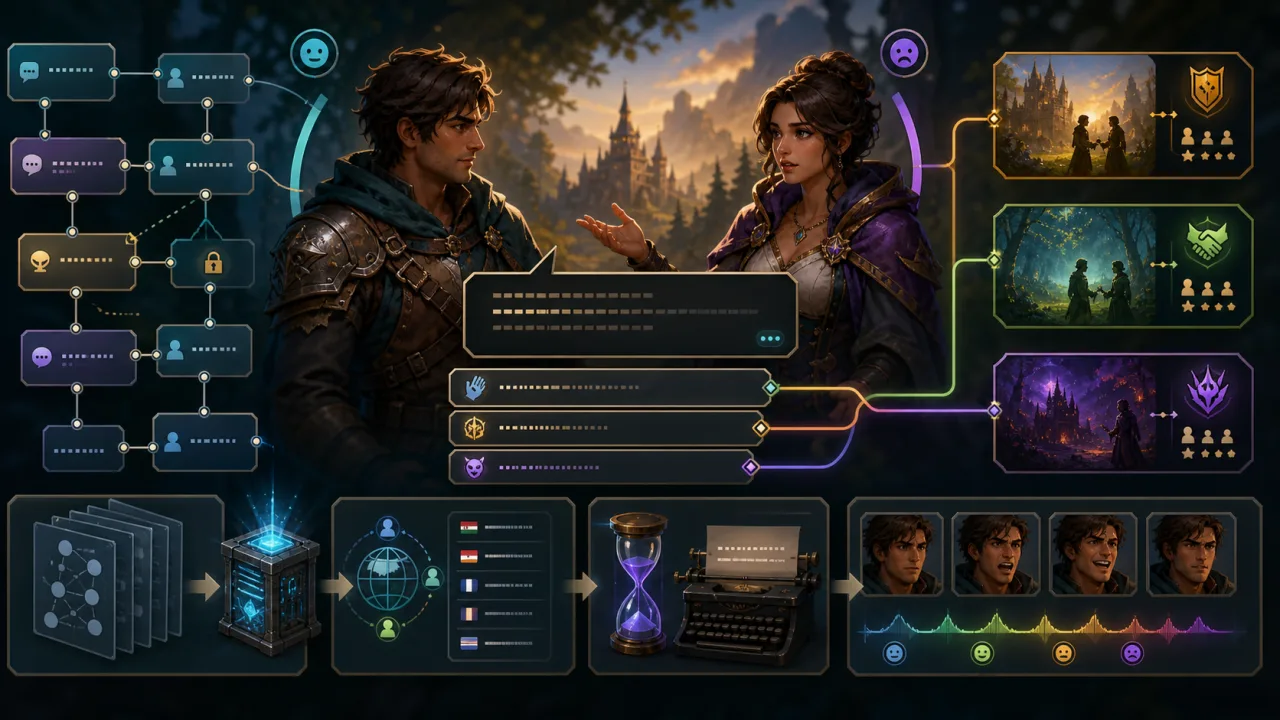
A dialogue system does more than place text beneath a portrait. It coordinates speakers, expressions, timing, choices, conditions, quest state, localization, audio, input, saving, and accessibility. A data-driven design keeps story content separate from rendering so writers can extend conversations without changing the game loop or duplicating interface logic.
Separate dialogue data from presentation
Store conversations as nodes in JSON or another authoring format. Each node can contain a stable ID, speaker ID, localization key, portrait expression, optional voice cue, timing hints, commands, conditions, and outgoing choices. The renderer should receive a resolved node and decide how it appears on the current screen.
Stable IDs matter. Save files, analytics, quest scripts, and tests should reference IDs rather than array positions, because writers will reorder and insert content throughout production.
Define a small node vocabulary
Start with a few clear node types: line, choice, branch, command, jump, and end. A line displays speech. A choice offers player responses. A branch selects a path from game state. A command changes state or triggers a safe event. A jump moves to another node without duplicating data.
Avoid embedding arbitrary code in dialogue files. Use a registry of named commands with validated arguments. This keeps content reviewable and prevents a typo from calling an unsafe or unrelated game function.
Build a deterministic conversation runner
The runner owns the current conversation ID, node ID, history, variables, and lifecycle state. It resolves conditions, emits presentation events, waits for input, applies approved commands, and advances to the next node. Only one transition should execute at a time.
Update dialogue state on the fixed simulation step when it can affect quests, inventory, or AI. The pattern in HTML5 Fixed Timestep Game Loop prevents high-refresh displays from advancing story state differently from slower devices.
Handle branching choices
Each choice needs a stable ID, localization key, destination node, optional condition, optional disabled reason, and optional command. Evaluate conditions when the menu opens and again before accepting a selection if game state can change concurrently.
Decide whether unavailable choices are hidden or shown as disabled. Disabled options can teach players about missing requirements, but they must have a clear explanation and accessible focus behavior.
For quest conversations, keep narrative state in the quest system rather than only inside the dialogue runner. The structures in HTML5 Game Quest Lines help conversations and objectives share one authoritative progression model.
Create a responsive dialogue panel
Use semantic HTML or accessible canvas overlays for the speaker name, text, portrait, and choices. Anchor the panel within safe areas, cap line length, and allow the text region to grow without covering essential controls. Portraits should crop consistently across aspect ratios.
On mobile, give choices large touch targets and enough vertical spacing. If the list is long, scroll within a clearly bounded panel and keep the currently focused option visible.
Implement typewriter text carefully
Reveal text by grapheme cluster rather than UTF-16 code unit so emoji, combining marks, and non-Latin scripts remain intact. Drive speed from elapsed time, not one character per frame. Punctuation may add a small pause, but writers need a way to override timing.
The first confirm press can complete the current line; a later press advances. Route these actions through an input buffer so one press cannot both finish and skip the line. HTML5 Game Input Buffering explains how to consume input once at the intended state.
Respect reduced motion and reading preferences
Offer instant text, adjustable reveal speed, automatic advance controls, and a persistent conversation log. Disable portrait bobbing, panel slides, or cursor pulses when reduced motion is enabled. The recommendations in HTML5 Reduced Motion Settings apply directly to dialogue interfaces.
Let players scale dialogue text independently from the rest of the HUD. Reflow content instead of shrinking the panel until it becomes unreadable. Use the principles in HTML5 Game Text Scaling to preserve hierarchy and touch targets.
Localize from the beginning
Store localization keys in nodes, not final English strings. Provide variables through named placeholders and validate that every locale contains compatible placeholders. Avoid concatenating fragments because word order and grammar vary between languages.
Allow expansion room for translated text and test right-to-left layouts. Speaker names, choice order, punctuation, portrait placement, and directional icons may need mirroring. HTML5 Game Localization provides a broader pipeline for fonts, assets, and locale fallback.
Integrate voice and captions
Voice clips should be optional attachments to lines, not the timing authority. Text must remain available even when audio is missing, muted, delayed, or unavailable in a locale. Track playback state separately from node state.
Offer independent voice, music, and effects controls using HTML5 Game Audio Settings. For important non-speech cues, apply the readable caption practices in HTML5 Subtitle and Caption Settings.
Coordinate portraits and expressions
Map speaker and expression IDs to assets in a separate character registry. A node might request speaker merchant and expression worried without naming a file path. This allows art changes, resolution variants, and locale-specific assets without rewriting conversations.
Preload the current portrait, the next likely portrait, and required voice cue. Release older assets after the conversation moves beyond them. Avoid loading every portrait for a long branching scene at once.
Use safe commands and events
Commands can grant an item, start a quest, set a flag, move a camera, or trigger an animation. Validate command names and arguments before the conversation begins. Apply state-changing commands exactly once, even if a line is reopened after a pause or save restore.
Separate reversible presentation events from irreversible gameplay commands. Replaying a portrait animation is harmless; granting the same reward twice is not. Record an execution token for commands that require idempotency.
Save and restore conversations
Persist the conversation ID, current stable node ID, variables, executed command tokens, choice history when needed, and presentation state such as whether the current line was completed. On load, rebuild the panel without re-running irreversible entry commands.
Version dialogue data. When a saved node no longer exists after an update, use an explicit migration table or resume from a safe checkpoint. Never silently jump to an unrelated array position.
Support interruption and priority
Define what happens when combat, a cutscene, a network event, or another conversation begins. Options include pause and resume, queue, cancel at a safe point, or reject the interruption. Give each conversation a priority and an owner.
Modal dialogue should suspend conflicting world input while preserving menu navigation and accessibility shortcuts. Nonmodal banter can coexist with play but needs a separate subtitle-style presentation.
Test with automated validation
Validate that every destination exists, every localization key resolves, every command is registered, every choice reaches a valid node, and intended conversations have an exit. Detect unreachable nodes and accidental infinite loops.
Run traversal tests with representative quest states and locales. Capture missing portraits, overflowing text, invalid placeholders, duplicate command execution, and restore failures before writers encounter them in a full playthrough.
Implementation checklist
- Use stable IDs and data-driven nodes.
- Keep presentation separate from progression state.
- Validate branches, commands, and destinations before runtime.
- Reveal text by grapheme cluster with adjustable speed.
- Build localization, text scaling, and reduced motion in early.
- Make commands idempotent across save and restore.
- Define interruption, input, and audio policies explicitly.
- Automate graph and content validation.
A maintainable dialogue system treats conversation as structured game data. With stable nodes, a deterministic runner, accessible presentation, and validated commands, HTML5 games can support rich branching stories without turning every new scene into a fragile set of special cases.