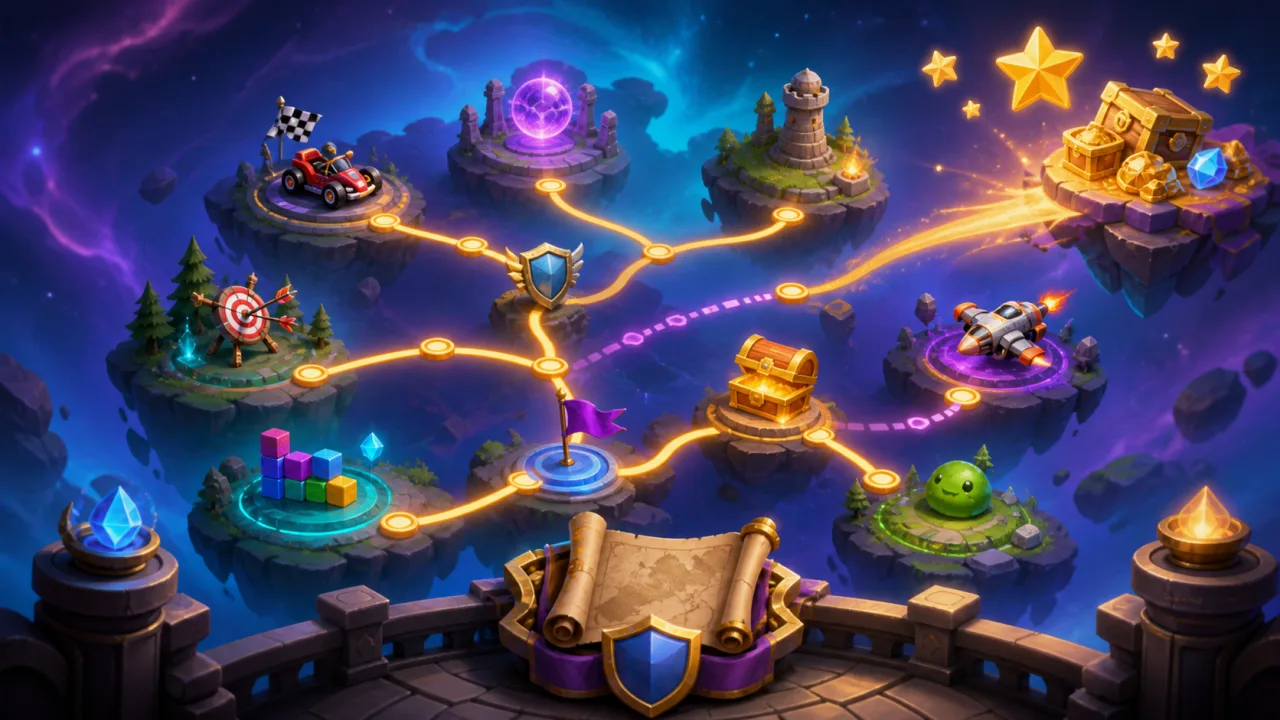
A quest line turns a collection of browser games into a connected journey. Instead of asking players to chase isolated points, it gives them a sequence of understandable goals, visible progress, and a satisfying reason to explore more of the portal. The best systems feel optional, fair, and consistent across desktop and mobile.
Start with a clear player promise
Define what the quest line offers in one sentence: discover new genres, master a skill, complete a themed adventure, or unlock a cosmetic collection. A focused promise keeps objectives and rewards coherent and helps players decide whether the journey suits them.
Model chapters, nodes, and states
Represent the quest as versioned data. A chapter contains nodes; each node has prerequisites, objectives, rewards, start and end rules, and a state such as locked, available, active, completed, or claimed. Keep presentation copy separate from completion logic so editors can improve wording safely.
Choose objectives players can understand
Use specific verbs and visible quantities: finish a level, collect an item, survive a round, or try games from two categories. Avoid vague instructions such as “play better.” Show current progress, the remaining requirement, and the destination game before the player launches it.
Balance single-game and cross-game steps
Single-game steps teach depth; cross-game steps encourage discovery. Alternate them so the quest does not feel like a list of unrelated clicks. When recommending the next game, explain why it fits and use the principles from personalized game recommendations without making progression depend on opaque personalization.
Enroll players explicitly
Let players preview a quest before joining. Enrollment should create a server-side quest instance containing the player, quest version, start time, and current node. Explicit enrollment makes analytics cleaner and prevents old activity from unexpectedly completing a new quest.
Design a small progress event schema
Games should emit a limited set of normalized events such as session started, level completed, score submitted, item collected, or match won. Include player ID, game ID, event ID, timestamp, and relevant numeric fields. Map game-specific events to portal objectives on the server.
Make events idempotent
Browser retries and reconnects can deliver the same event twice. Give every progress event a unique ID and store processed IDs for an appropriate window. Updating progress and recording the event should happen in one transaction so rewards cannot be granted twice.
Verify important progress on the server
Do not trust a client message that simply says a quest is complete. Validate score ranges, session duration, sequence, game version, and rate limits. High-value rewards need stronger checks than low-stakes discovery steps. Suspicious patterns should enter the workflow described in the game moderation queue guide.
Save progress across devices
Store authoritative progress on the portal account and cache it locally only for responsive UI. Reconcile offline events carefully when the player reconnects. The data ownership and conflict patterns in HTML5 game cloud saves are useful here too.
Support guest players gracefully
Guests can start a quest with a signed anonymous identifier, but explain which progress is device-bound. Offer account linking before a meaningful reward or device transfer, and preserve eligible progress during conversion. See supporting guest players for consent-friendly upgrade moments.
Use branching paths with purpose
A branch should offer a genuine choice, such as puzzle versus action, not hide the easier route. Show whether paths rejoin and whether players can revisit the unchosen branch. Keep required nodes limited so one inaccessible or unavailable game cannot block the whole journey.
Reward mastery, not spending
Use profile cosmetics, badges, portal themes, collection items, or access to optional challenges. Avoid rewards that pressure players to spend or create pay-to-progress gates. Tie major rewards to effort that can be verified and explain claim deadlines clearly.
Connect quests to achievements
Quests provide narrative sequence; achievements recognize lasting accomplishments. A completed chapter can award a badge without duplicating every objective in both systems. Coordinate definitions with the framework in game achievement badges.
Integrate daily challenges carefully
A quest may include a daily challenge, but missed days should not permanently strand a player. Offer alternate nodes, grace windows, or a rotating equivalent. Keep short repeatable goals distinct from the longer journey described in HTML5 daily challenges.
Design for mobile and accessibility
Use large touch targets, concise objective labels, strong contrast, reduced-motion support, keyboard navigation, and screen-reader announcements when progress changes. Never rely on color alone to distinguish locked and completed nodes. Test the quest map at narrow widths and high text zoom.
Build a useful quest interface
Show the current node first, with one primary action to continue. A map can reveal nearby milestones without overwhelming new players. Add a compact in-game progress panel, a portal-level quest page, and a clear return path after each session.
Version live quests safely
Published quests should be immutable. Create a new version when objectives or rewards change, and define whether active players remain on the old version or migrate. Provide compensation when removing a broken node, and keep an audit trail of editorial changes.
Measure quality, not only completion
Track enrollment, node starts, completion time, drop-off, game launches, reward claims, and return rate. Segment by device and guest/account status. A high completion rate can still signal a quest that is trivial, while a sharp drop at one node may reveal confusing copy or technical failure.
Protect player wellbeing
A quest should never encourage unhealthy session lengths. Cap repeatable progress, show time expectations, respect pause and playtime tools, and avoid loss-framed countdowns. Tournaments can coexist with quests, but keep competitive rules separate using the safeguards in building HTML5 game tournaments.
Launch with a practical checklist
- Define the promise, audience, and completion window.
- Version nodes, objectives, and rewards.
- Normalize and deduplicate progress events.
- Verify valuable progress server-side.
- Support guests, mobile layouts, and accessible alternatives.
- Test branches, migrations, reward claims, and failure recovery.
- Review analytics and player feedback after launch.
Quest lines succeed when the portal makes progress trustworthy and the next step obvious. Start with one short journey across a few well-matched games, learn where players hesitate, and expand only after the system proves fair, understandable, and resilient.