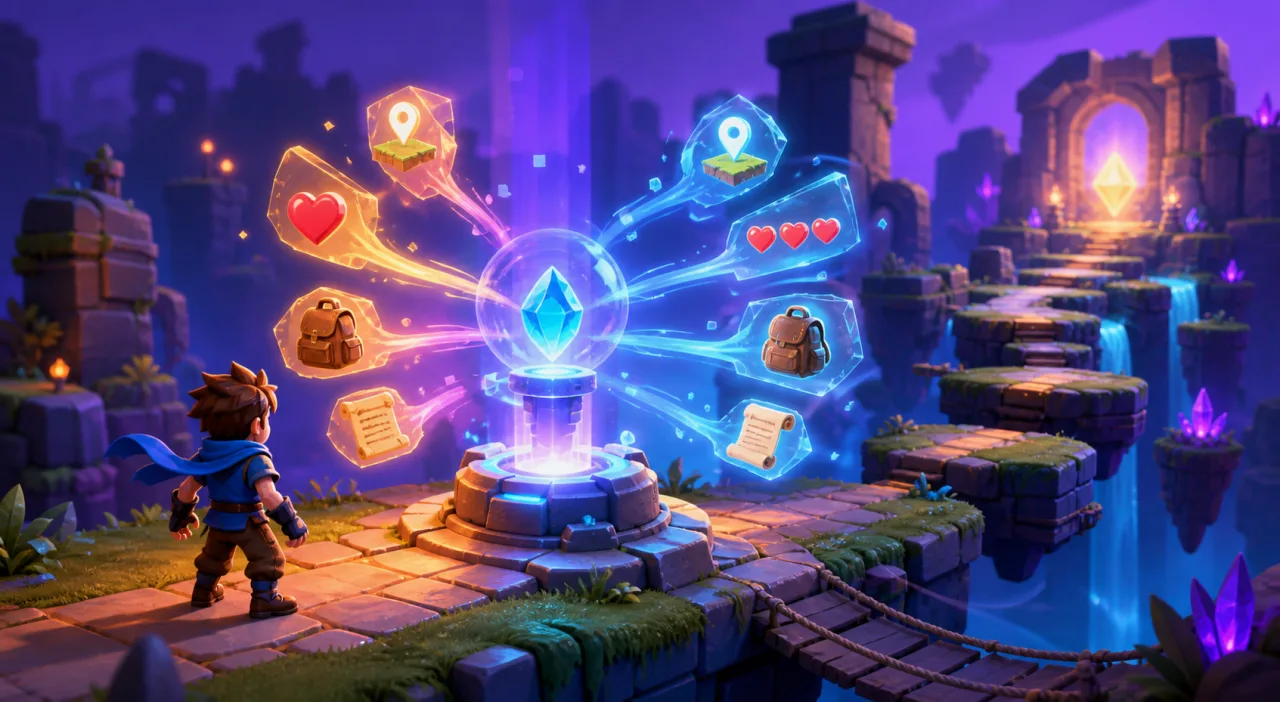
A checkpoint should make failure feel fair: the player returns to a known-safe moment with the same meaningful state they had before the interruption. In an HTML5 game, that promise requires more than storing an x and y coordinate. A reliable checkpoint system defines a complete, versioned state snapshot, validates it, and restores it in a deterministic order.
This guide focuses on in-session checkpoints and short recovery saves. For longer-lived progress across devices, pair the design with a cloud save strategy. If you need exact simulation playback for debugging or competition, see the separate guide to HTML5 game replay systems.
Define what a checkpoint guarantees
A checkpoint is a promise about what will be restored. Write that promise before writing serialization code. A simple platformer may guarantee player position, health, inventory, active abilities, collected key items, objective progress, and the state of nearby hazards. A strategy game may also need turn number, resources, spawned units, fog-of-war data, and random-number generator state.
Separate durable gameplay state from presentation state. Camera shake, particle emitters, animation frame counters, temporary audio, and DOM nodes usually should not be serialized. Recreate them from the restored gameplay model.
Capture only at safe boundaries
Do not save halfway through a physics step, damage calculation, inventory transaction, or scene transition. Mark explicit capture boundaries where gameplay systems have settled: after the player reaches a beacon, after an encounter completes, or at the end of a turn.
Queue the capture and execute it after the current update cycle. This prevents a snapshot where health has decreased but the corresponding death state has not been applied, or where an item has left the world but has not yet entered the inventory.
Build a deterministic snapshot
Use a plain, serializable data object with stable identifiers. Avoid raw engine objects, closures, circular references, DOM elements, and asset instances. A practical snapshot can include:
- schema version, game build, level ID, checkpoint ID, and capture time;
- player transform, health, energy, status effects, equipment, and inventory IDs;
- completed objectives, opened gates, defeated encounter IDs, and collected unique items;
- world variables that materially affect the next action;
- random seed or generator state when randomness affects restoration.
Use identifiers rather than array positions. Content updates often reorder entities, so an ID such as gate-temple-east survives changes better than “object 17.”
Version the data from the first release
Add a numeric schema version before the game ships. When the snapshot shape changes, migrate older data through small, testable steps: version 1 to 2, then 2 to 3. Never guess missing values silently when they affect progression. Choose an explicit safe default, restart the current section, or ask the player to load an earlier compatible save.
Keep the game build separate from the schema version. A new build may not change save data, while one build can support several schema versions during a transition.
Write atomically
A browser tab can close, lose power, or be suspended during a write. Serialize to a temporary key, validate the result, and then replace the active checkpoint reference. With IndexedDB, use one transaction for the snapshot and its metadata. With localStorage, keep payloads compact and use a two-key commit pattern.
Maintain at least one previous known-good checkpoint. If the newest record is corrupt, the game can offer a safe fallback instead of erasing all progress. Cloud synchronization should upload immutable checkpoint revisions and update the “current” pointer only after the server confirms the write.
Validate before trusting a checkpoint
Treat stored client data as untrusted. Check the schema version, required properties, types, ranges, level membership, content identifiers, and payload size before restore. A checksum can detect accidental corruption, but it is not proof against deliberate tampering. Competitive rewards and server-owned progression must be validated by authoritative server rules.
Reject impossible values such as negative inventory counts, a position outside the level bounds, or an objective that requires a missing prerequisite. Log a concise local error code without including personal data.
Restore in a predictable order
Restoration should be idempotent: running it twice must not duplicate rewards or spawn extra enemies. A robust order is:
- pause input, simulation, timers, and network-driven gameplay events;
- load the correct level and static content;
- apply persistent world decisions and remove already-collected unique objects;
- spawn or reset dynamic entities by stable ID;
- restore player inventory, abilities, health, and status;
- place the player at a validated safe transform;
- restore the random generator and scheduled gameplay timers;
- rebuild presentation systems, camera, audio, and UI;
- resume input and simulation.
Make each step await completion before continuing. A restore race can place the player before the level collision data exists or let an enemy attack while inventory is still loading.
Prevent respawn loops and softlocks
The saved position should be a checkpoint anchor, not necessarily the exact last frame. Validate ground support, collision clearance, camera bounds, and escape routes. Clear short-lived hazards near the anchor or grant a brief invulnerability window. Never save after lethal damage has become unavoidable.
Track repeated deaths after the same restore. After several rapid failures, offer to restart the encounter, return to an earlier checkpoint, or adjust assistance. This can work alongside adaptive difficulty without silently changing the player's chosen mode.
Make recovery clear and accessible
Show a consistent visual and audio confirmation only after the checkpoint write succeeds. Do not claim “saved” while the transaction is still pending. Provide an accessible non-color-only cue and avoid flashes that can trigger photosensitive players.
Let players restart from the current checkpoint through the pause menu, and explain whether closing the tab preserves progress. Good recovery belongs in the broader onboarding flow. On mobile, keep the recovery controls large, safe-area aware, and compatible with the recommendations in the touch controls guide.
Protect performance
Checkpoint capture should not freeze the main thread. Keep snapshots small, serialize after critical animation or physics work, and split expensive compression across tasks when necessary. Measure on lower-powered phones, not only desktop browsers. Avoid capturing every frame or every coin pickup; mark the state dirty and commit at deliberate boundaries.
Test the system as a matrix
- Restore each checkpoint after a death, refresh, tab suspension, and browser restart.
- Interrupt a write and confirm the previous checkpoint remains usable.
- Load every supported older schema and verify migrations.
- Test missing assets, renamed entity IDs, and changed level geometry.
- Restore twice and confirm rewards, enemies, and objectives are not duplicated.
- Test offline, slow storage, quota errors, and failed cloud synchronization.
- Check keyboard, controller, mouse, and touch recovery paths.
- Verify screen-reader labels, reduced-motion behavior, and non-color confirmation.
Checkpoint checklist
- Document the exact restoration guarantee.
- Capture only after gameplay systems settle.
- Serialize plain data with stable IDs and a schema version.
- Write atomically and retain a known-good fallback.
- Validate ranges, references, payload size, and progression rules.
- Restore systems in a deterministic, idempotent order.
- Use safe anchors and provide softlock recovery choices.
- Confirm success accessibly and test on lower-powered mobile devices.
A reliable checkpoint system is a small state-management architecture, not a coordinate bookmark. When capture boundaries, versioning, atomic storage, validation, and restore order are designed together, players can trust that failure or interruption will not waste their progress.