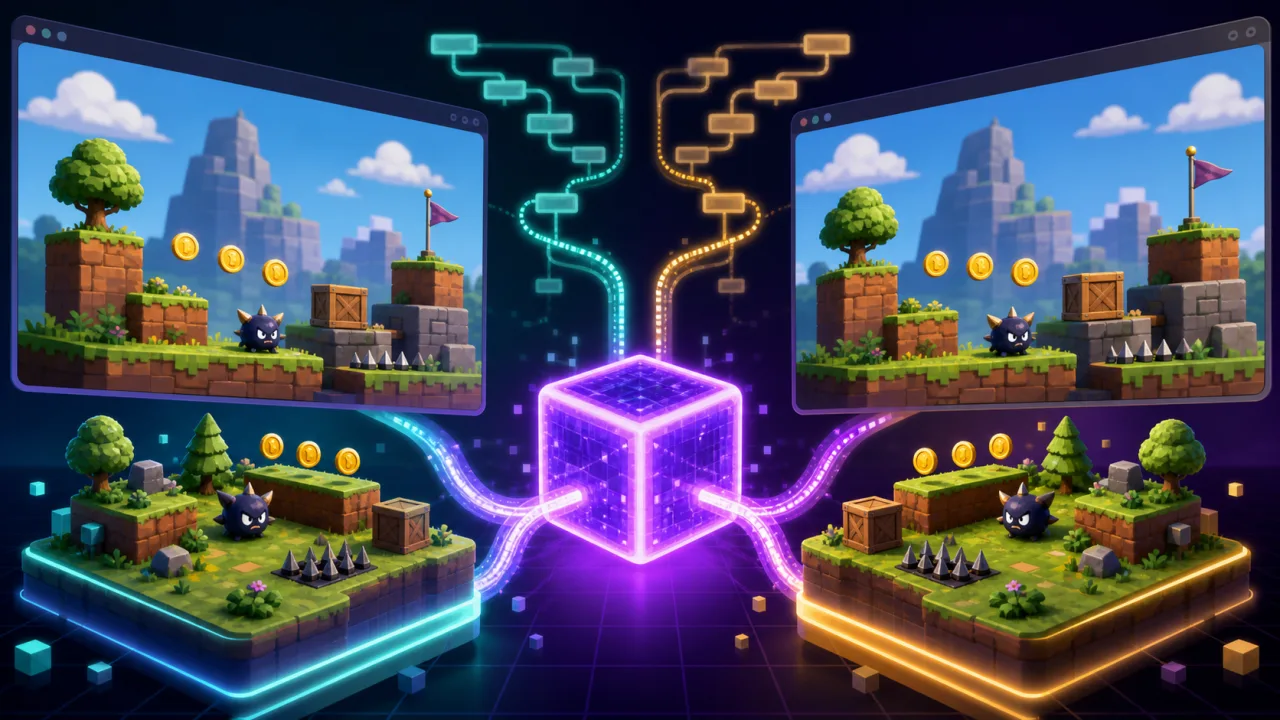
Deterministic random seeds let an HTML5 game reproduce the same “random” outcome on demand. With a seeded pseudo-random number generator, developers can replay bugs, build fair daily challenges, verify procedural levels, and keep simulations consistent across browsers.
What a deterministic seed changes
JavaScript's built-in Math.random() does not let you choose or restore its internal state. That is fine for decorative effects, but it becomes a problem when randomness affects level layouts, enemy behavior, loot, or physics. Two players cannot share the same challenge, and a tester cannot reliably recreate the run that produced a bug.
A seeded generator starts from a known integer and produces the same sequence every time. The sequence is not truly random, but it is predictable only when the seed and algorithm are known. For gameplay systems, that reproducibility is often more useful than entropy.
Use a small, explicit generator
Keep the generator in one module and route gameplay randomness through it. A compact function such as Mulberry32 is suitable for many non-cryptographic game tasks:
function createRandom(seed) {
  let state = seed >>> 0;

  return function random() {
    state += 0x6D2B79F5;
    let value = state;
    value = Math.imul(value ^ (value >>> 15), value | 1);
    value ^= value + Math.imul(value ^ (value >>> 7), value | 61);
    return ((value ^ (value >>> 14)) >>> 0) / 4294967296;
  };
}

const random = createRandom(20260823);
const coinX = Math.floor(random() * 800);
This generator is fast and repeatable, but it is not cryptographically secure. Never use it for passwords, authentication tokens, purchases, or any outcome that must resist manipulation.
Separate gameplay and cosmetic randomness
A common determinism bug appears when particles, sound variations, or menu animations consume values from the same sequence as gameplay. A harmless visual effect can then change enemy spawns later in the run.
Create independent streams for systems that should not influence one another. Derive stable child seeds for the world, combat, loot, and cosmetic effects. Then a change to particle density will not alter procedural terrain or reward placement.
const worldRandom = createRandom(hashSeed(seed, 'world'));
const lootRandom = createRandom(hashSeed(seed, 'loot'));
const fxRandom = createRandom(hashSeed(seed, 'effects'));
Document the generator version as part of the run. If you change the algorithm or the order of random calls, the same seed may produce a different result.
Choose and share seeds safely
A seed can come from a daily UTC date, a server-issued challenge ID, a saved run, or a user-entered code. Normalize the value into an unsigned 32-bit integer with a stable hash. Do not rely on JavaScript's process-specific object ordering or local time zone when generating shared challenges.
Daily seeds pair naturally with daily challenge systems. Generate the official seed on the server, publish it with a version number, and validate important results server-side if rankings or rewards are involved. The seed creates equal starting conditions, but it does not prevent client tampering.
Capture state for replays and checkpoints
Saving only the initial seed is enough when every update is deterministic and every input is replayed in the same order. Real games may also depend on network events, floating-point behavior, frame timing, or asynchronous asset loading. Record the generator state at checkpoints and store external events that can change simulation order.
For debugging, combine the seed with the input timeline from a reliable replay system. Save seed version, simulation tick, random stream states, and a lightweight state checksum. A checksum mismatch tells you exactly where the replay diverged.
When resuming a run, restore random state alongside the data described in the checkpoint system guide. Recreating the generator from the original seed and guessing how many values were consumed is fragile after game updates.
Keep randomness out of frame-rate timing
Do not call gameplay randomness from render loops that run a variable number of times. Consume random values only during fixed simulation steps or explicit events. The same input sequence should trigger the same random calls on a 60 Hz display and a 144 Hz display.
Input timing also matters. Process commands on simulation ticks, then apply the same deterministic order used by your input buffering system. This prevents small browser scheduling differences from changing which event consumes the next value.
Test determinism automatically
Add a test that runs the same seed twice and compares important outputs: map tiles, spawn positions, loot tables, and state checksums. Run another test with a different seed to ensure the generator is not accidentally constant. Finally, test serialization by saving and restoring the generator state midway through a sequence.
- Use one documented seeded generator for gameplay.
- Create separate streams for unrelated systems.
- Store seed, algorithm version, and current state.
- Advance randomness only during deterministic events.
- Validate shared competitive outcomes on the server.
- Compare checksums in automated replay tests.
Seeded randomness gives HTML5 games a practical foundation for reproducible bugs, fair shared content, and dependable replays. The key is to treat random state as part of the game state rather than as an invisible global helper.