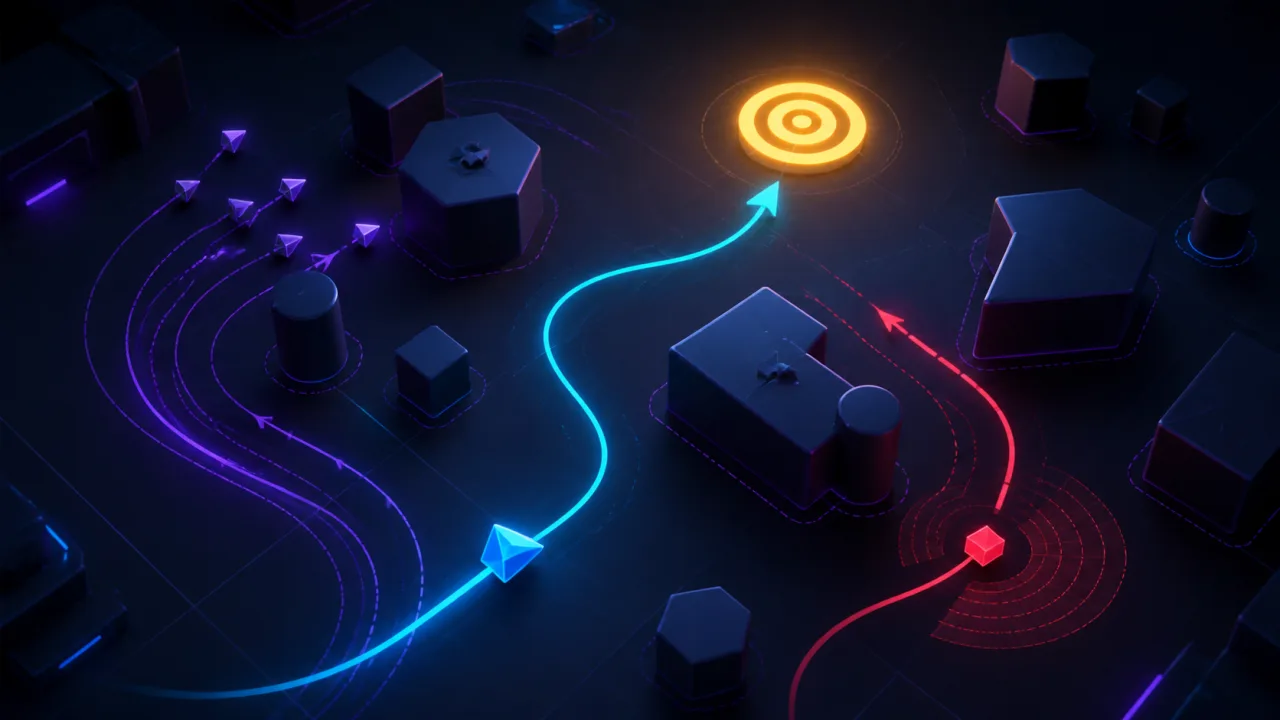
Excerpt: Steering behaviors make game agents move with weight and intention instead of snapping along rigid paths. This guide builds seek, arrive, flee, obstacle avoidance, separation, alignment, and cohesion for responsive HTML5 games.
Pathfinding answers a strategic question: which route reaches the destination? Steering answers a local movement question: how should an agent accelerate during the next simulation step? Combining the two produces characters that follow valid routes while still slowing naturally, avoiding neighbors, and reacting to nearby hazards.
The steering model
Represent each agent with position, velocity, maximum speed, maximum acceleration, and a physical radius. Every behavior returns a desired acceleration vector. The movement system combines those vectors, clamps the result, and integrates velocity and position on a stable timestep.
function updateAgent(agent, dt) {
  const steering = computeSteering(agent);
  steering.limit(agent.maxAcceleration);

  agent.velocity.addScaledVector(steering, dt);
  agent.velocity.limit(agent.maxSpeed);
  agent.position.addScaledVector(agent.velocity, dt);
}
Keep the movement update inside a fixed-timestep game loop. Variable time steps make acceleration, damping, and avoidance feel different when frame rate changes.
Seek: move toward a target
Seek computes a direction from the agent to the target, normalizes it, scales it to maximum speed, and subtracts the current velocity. That subtraction is important: the result is a velocity correction rather than a direction snap.
function seek(agent, target) {
  const desired = target.clone().sub(agent.position);
  if (desired.lengthSq() === 0) return new Vec2(0, 0);
  desired.setLength(agent.maxSpeed);
  return desired.sub(agent.velocity);
}
Seek is direct and energetic, but it overshoots a stationary target because the agent never plans to brake.
Arrive: approach without overshooting
Arrive adds two radii. Inside the stop radius, desired speed becomes zero. Between the stop radius and slow radius, desired speed scales with distance. Outside the slow radius, the agent moves at maximum speed.
- Stop radius: how close is close enough.
- Slow radius: where braking begins.
- Time to target: how aggressively velocity corrects toward the desired value.
Use hysteresis if an agent flickers between idle and moving near the boundary. A slightly larger exit radius prevents rapid state changes.
Flee and evade
Flee reverses seek: desired velocity points away from a threat. Evade first predicts where a moving threat will be after a short look-ahead, then flees from that predicted position. Clamp prediction time so distant targets do not produce unrealistic forecasts.
The decision to flee belongs in the behavior layer or a finite state machine. Steering should execute the selected motion rather than decide the character's goals.
Obstacle avoidance
Project a feeler or capsule ahead of the agent along its velocity. Find the nearest obstacle intersecting that corridor, then steer laterally away and add a braking force as distance closes. Scale look-ahead with speed: fast agents need more warning, while slow agents can use a shorter sensor.
Do not query every obstacle. Use the same spatial hash grid that supports nearby-agent lookup, and test only obstacles in the overlapping cells.
| Signal | Low value | High value |
|---|---|---|
| Look-ahead distance | Agile but late reactions | Early, smoother avoidance |
| Lateral force | Soft turns | Sharp evasive turns |
| Braking weight | Maintains speed | Slows near hazards |
| Agent radius padding | Tight gaps | Safer clearance |
Separation, alignment, and cohesion
These three local rules create flocking and crowd motion:
- Separation: steer away from close neighbors, weighting nearer agents more strongly.
- Alignment: steer toward the average velocity of nearby agents.
- Cohesion: arrive toward the local center of neighboring positions.
Use different radii for the behaviors. Separation should react in a small personal space, while alignment and cohesion can use a wider neighborhood. Exclude the current agent and protect divisions against zero distance.
Combine behaviors safely
Simply adding every full-strength vector often creates cancellation, vibration, or excessive acceleration. Three common combination strategies are useful:
- Weighted blend: multiply each vector by a tunable weight, sum, then clamp. Easy to debug and good for simple agents.
- Prioritized accumulation: apply high-priority safety behaviors first and spend the remaining acceleration budget on lower-priority goals.
- Behavior arbitration: select one behavior or mode based on state, such as evade, follow path, or idle.
Prioritized accumulation works well when collision avoidance must win over arrival. Let obstacle avoidance and separation consume the budget before seek, alignment, or cohesion.
const steering = new Vec2();
addLimited(steering, obstacleAvoidance(agent), maxAccel);
addLimited(steering, separation(agent), maxAccel);
addLimited(steering, followPath(agent), maxAccel);
addLimited(steering, arrive(agent, target), maxAccel);
Connect steering to A* paths
Use A* pathfinding to produce collision-safe waypoints. Steering then seeks or arrives at a look-ahead point on that path. Advance the waypoint only after the agent enters a tolerance radius, or project the agent onto the path and choose a target farther along the segment for smoother motion.
Repath when the destination changes materially, a dynamic obstacle invalidates the route, or the agent remains stuck beyond a timeout. Do not run a full path search every frame.
Prevent jitter and deadlocks
- Use stable neighbor ordering or deterministic tie-breaking.
- Add a small velocity dead zone near stopped targets.
- Limit how quickly the chosen avoidance side can flip.
- Use radius padding so visual sprites do not overlap.
- Detect low progress and temporarily increase priority for separation or repathing.
- Avoid random impulses unless they use deterministic seeds for reproducible tests.
Performance for many agents
Update nearby-agent queries through a spatial index, reuse vectors instead of allocating them in inner loops, and spread expensive decisions across frames. Steering itself is usually cheap; neighbor and obstacle queries are the main scaling cost.
Track update duration, neighbor counts, collision corrections, and stalled-agent events with frame-time telemetry. If temporary vector allocation becomes measurable, the patterns in object pooling can reduce garbage collection pressure.
Debug visually
Draw the agent velocity, each behavior vector, the final acceleration, perception radii, obstacle feelers, and current path target in distinct colors. Add toggles so one behavior can be isolated. Most tuning problems become obvious when the competing forces are visible.
Practical test cases
- Seek a stationary point from several starting velocities.
- Arrive without overshooting at both high and low frame rates.
- Avoid one obstacle at maximum speed.
- Pass two agents through a narrow corridor without endless side switching.
- Move a flock around a corner while preserving separation.
- Follow an A* path after a waypoint is removed or blocked.
- Spawn hundreds of agents and verify the update stays within its frame budget.
Shipping checklist
- Keep behavior output in acceleration units.
- Clamp acceleration and speed after combining forces.
- Use a fixed simulation step.
- Give safety behaviors higher priority than goal seeking.
- Index nearby agents and obstacles spatially.
- Separate decision state from movement execution.
- Expose weights, radii, and limits as data rather than scattered constants.
- Profile real crowd sizes and slower mobile devices.
Final takeaway
Steering behaviors are small vector rules that become powerful when combined carefully. Start with seek and arrive, add obstacle avoidance and separation, then layer alignment, cohesion, prediction, and path following. With stable integration, priority budgeting, and visual debugging, HTML5 game agents can move naturally without sacrificing responsiveness or performance.