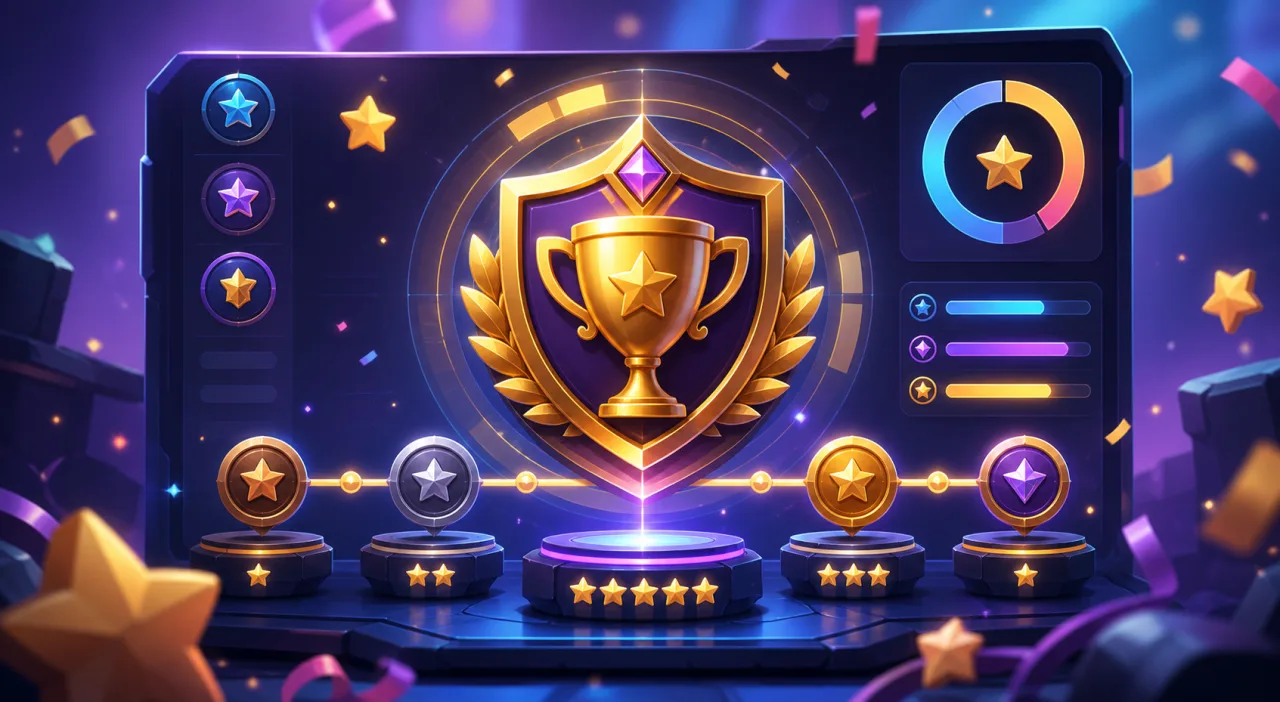
Achievement badges give players clear goals beyond a single high score. Used well, they highlight exploration, mastery, consistency, and community participation. Used poorly, they become noisy pop-ups or reward repetitive behavior that does not make the portal more enjoyable.
This guide shows how to design a secure, accessible achievement system for an HTML5 game portal, from data modeling and unlock checks to progress UI, analytics, and abuse prevention.
Start with meaningful achievement goals
Define badges around actions the portal can verify reliably. Good examples include completing a first game session, trying games from several categories, returning on different days, reaching a legitimate score threshold, or finishing a game-specific challenge exposed by a trusted integration.
Avoid achievements based only on page refreshes, ad clicks, or endless repetition. The goal is to help players discover value, not inflate engagement metrics.
Design a simple data model
Store each achievement as a stable record with an internal key, public name, description, icon, category, points or rarity, visibility, and version. Keep progress rules separate from presentation so designers can improve copy or artwork without changing the unlock logic.
For each player, store the achievement ID, progress value, unlocked timestamp, rule version, and source event. A unique constraint on player and achievement prevents duplicate unlocks. If your portal supports cross-device profiles, connect this record to the approach in our cloud save guide.
Use server-verified events
Do not trust a browser message that simply says “achievement unlocked.” Client code can be modified. Send narrow gameplay events to the server, validate the authenticated player and game, then evaluate rules on trusted data whenever possible.
Score-based badges should follow the same validation principles as fair game leaderboards: rate limits, plausible score ranges, replay protection, and audit logs. If a third-party game cannot provide trustworthy events, restrict achievements to portal-level actions the server can confirm.
Make unlock processing idempotent
The same event may arrive twice because of retries, tab restoration, or a slow network. Give each event an idempotency key and process it once. Insert the unlock inside a transaction, then queue notifications after the database confirms success.
This prevents duplicate badge records, repeated rewards, and multiple pop-ups. It also makes recovery safer if a worker stops halfway through processing.
Track progress without excessive writes
Players enjoy seeing progress such as “7 of 10 categories explored,” but updating the database on every tiny action can create load. Aggregate frequent events in memory or a queue, apply bounded updates, and flush at sensible checkpoints.
Use integer counters or explicit milestone states instead of fragile floating-point percentages. Recalculate from authoritative history when possible so support staff can repair inconsistent progress.
Build an accessible badge interface
Create a dedicated achievements page with earned, in-progress, locked, and hidden sections. Each badge needs a concise name, plain-language requirement, meaningful icon alternative text, progress text, and sufficient color contrast. Do not communicate rarity or completion by color alone.
On mobile, keep cards readable and tap targets large. The responsive practices in making HTML5 games work better on mobile browsers also apply to badge grids, progress bars, and notification placement.
Keep notifications respectful
An unlock toast should be brief, dismissible, and non-blocking. Never cover essential game controls or interrupt a timed action. Queue multiple unlocks instead of stacking them across the screen, and let players mute sounds or celebration effects.
Link the notification to the badge detail page so interested players can understand why it unlocked. Players who prefer uninterrupted play should be able to review achievements later.
Connect badges to discovery
Achievements can encourage players to explore categories or overlooked titles, but recommendations should remain relevant. A “Puzzle Explorer” badge might invite a player to try three puzzle subgenres and then surface related games using the patterns in our game search and filter guide.
Do not require paid actions, ad interactions, or invasive sharing. Keep the route to completion transparent and fair.
Separate badges from ratings and favorites
Achievements represent completed goals; ratings represent player opinions; favorites represent personal collections. Keep these systems distinct in the database and interface. Our guides to useful game ratings and favorites explain those different intents.
You may display them on the same profile page, but do not turn a high rating or favorite action into a coerced badge requirement. That would distort genuine feedback.
Plan for versions and retired achievements
Rules change as games and portal features evolve. Give each rule a version and record which version produced an unlock. If a badge becomes impossible, retire it without deleting player history. Mark it as legacy and explain that it is no longer available.
When reducing a requirement, decide whether existing progress should unlock automatically. Run migrations in small, auditable batches and keep rollback information.
Measure quality, not just unlock volume
Track views of the achievements page, progress completion, unlock errors, notification dismissals, and whether badge-driven discovery leads to healthy play sessions. Segment by device and game category without collecting unnecessary personal data.
A badge with a very high unlock rate may be a useful onboarding step, while a rare badge may signal mastery. Neither is automatically good or bad; compare the outcome with the goal.
Implementation checklist
- Define verifiable goals and stable achievement keys.
- Validate events on the server and rate-limit submissions.
- Make event and unlock processing idempotent.
- Store progress, unlock time, source, and rule version.
- Design accessible cards, progress text, and non-blocking notifications.
- Test mobile layouts, offline retries, duplicate events, and account migration.
- Document retirement and support procedures.
- Review analytics for player value and abuse signals.
Practical takeaway
A strong achievement system is a trustworthy progression layer, not a collection of decorative pop-ups. Start with a small set of meaningful goals, verify every unlock, make progress understandable, respect player attention, and expand only when the data shows that badges improve discovery or mastery.